Showing posts with label Constitution. Show all posts

Sunday, April 01, 2007

The will of the people....?

How does one determine the will of the people? I mean, when a legislature states with impunity that it represents the will of the people in a matter that clearly divides the people along ideological lines, can it really be taken at its word?

It is paradoxical at most to state that one represents or is capable of aggregating the will of the people. This flies in the face of the fact that the will of only a sub-section of the people are consulted, and only their views and opinions accorded the respect and attention that should have ideally been accorded to the people as a whole.

India is not a direct democracy. By definition, a direct democracy is one wherein citizens or the demos vote on all major policy decisions. In contrast, India's representative democracy does not empower the people to such an extent. I quote Wikipedia as follows:

A characteristic of representative democracy is that while the representatives are elected by the people, to act in their interest, they retain the freedom to exercise their own judgment as how best to do so.

Essentially, this would mean that although the representatives are elected to represent the people, they are sufficiently empowered to determine on their own as to what constitutes public interest. It is not necessary, but is generally and ideally expected, that such a judgment would approximately mirror the 'will of the people'. That it may not is a definitely accepted possibility, but that would be one that cannot be repudiated.

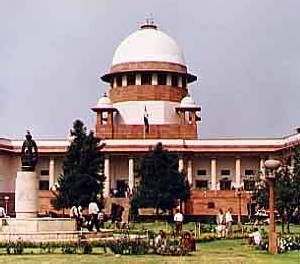
The Government, shaken after the Supreme Court stayed the reservation process for the OBC communes on technical grounds, has made an appeal that since Parliament had unanimously affirmed the legislation, it represents the will of the people. A Union Minister has even gone to extent of stating that by staying a process affirmed by the 'will of the people', the judiciary has implied that it is 'against the people'. To state that Parliament is infallible just because it is the sole representative arm of the State is to confer too great prerogatives on it.

Any representative arm is susceptible of the allure of interpreting a situation in light of their own biases and prejudices. This is irrespective of whether this interpretation is true of the general populace's viewpoint about the same.

That such an 'erroneous' interpretation may not be challenged would be a severe infringement on the liberties of the people, as it implies that even if a law be bad, it cannot be revoked simply because the legislature had approved it. Agreed that if a bill's provisos are seen and known to be bad, the people can proclaim that they would not approve of it, but what if the legislature sees such a proclamation as not truly representative of the people and insists on its own legitimacy as the sole guardians of public interest?

The concept of judicial review is based on the idea that the Constitution expresses the true will of the people, while the decisions of any particular legislature represent only the shifting, changeable will of that particular legislature. The will of the legislature may not trump the will of the people, as expressed in the Constitution, and therefore laws which violate the Constitution are void—and the judges are the people who decide whether the a law does go that far.

History is replete with examples wherein despite the presence of representative democracies, some of the most heinous crimes have been permitted to take place against the people, that too with the compliance of the legislature.

While I don't think that the reservation policy is a crime against the people, in its current form, it is still an aberration. It needs reform, reform which the Supreme Court has indicated viz. the basis for the caste populace calculation and the adherence to the creamy layer proviso (which would ideally ensure that only the needy get the benefits). A failure to look into these areas would be a transgression against the people for sure. Whether such a policy then truly represents the will of the people needs to be investigated.

Friday, March 30, 2007

Reservation woes...

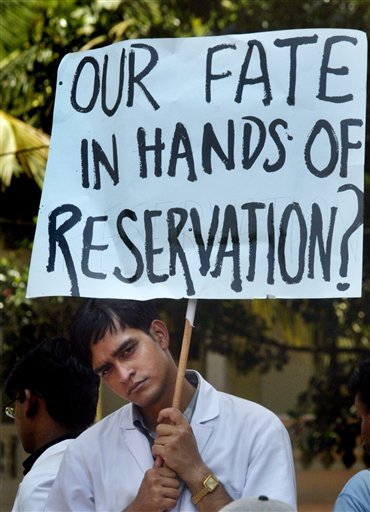
The Supreme Court has asked the Union Government to put on hold its ambitious and controversial program to increase affirmative action quotas in educational institutions. These quotas increases are mainly aimed at the Other Backward Castes section of Indian society, a section that slipped into the ambit of affirmative action after the Mandal Commission's report being implemented in 1990 by the then incumbent V.P. Singh Government. These communes were then deemed eligible for affirmative action benefits by virtue of them being socially and economically backward, as also because doing so would have been in conformity with the Directive Principles of State Policy. The percentage of seats which would be reserved for members of these communes has been fixed at 27 percent of the total, in keeping with their numeric strength as per the 1931 census.

And that is where the entire policy fell foul of the court. That a policy should be formulated keeping as its basis a census conducted more than 70 years prior has baffled the court, and not without reason. Does the Government wish to insinuate that the quantum of the population belonging to these communes has remained frozen at the same level for over a century? While it is very much possible that the communes might now comprise a reduced percentage of the total populace, and this prospect would be most attractive to those opposing these reservations, it is equally likely that they might now constitute a higher percentage.

This brings us to the main point of this blog. I have always maintained that affirmative action on the basis of commune or creed is largely self-defeating as it rarely if ever addresses the real issues, and risks being monopolized by the more affluent sections of the communes/creeds in question. The standard mode of implementation followed by the Indian state also doesn't allow for much reform on a continuous basis, something that is imperative for an affirmative action program to be deemed to be truly responsive to the needs of the communes whose troubles it wishes to alleviate.

The haste by which the Government was attempting to push this piece of legislation and its inability to answer queries on why the 1931 census and not the more recent 2001, or for that matter, even the 1991 census (in case the 2001 census' computations should still be ongoing) was employed to determine the exact percentage of seats to be reserved under the program proposed somehow suggests that the State was trying to subvert the process of natural justice in its pursuit to be seen as socially aware.

I don't wish to support such a view. The State was being its usual self: plain old incompetent. I mean, it's a cardinal rule that you base your calculations on the most recent data, data which would, logically, be the most accurate approximation to the current situation. Then how could the State mess up so badly?

This blog has always stated its support for affirmative action based on economic considerations. While economics alone cannot be deemed to be enough, by that record, even a communal identity should also not be enough. The case for economics as 'one' of the parameters, and perhaps this being already a part of the system by way of the 'creamy layer' proviso, is strengthened by the fact that while it is accepted that the designated communes do suffer from a systemic bias against them, once a member becomes sufficiently emancipated by way of his financial and social status, the member shouldn't then be able to claim the benefits of affirmative action. Should such a member's offspring, by some quirk of fate, again fall short of the emancipation definition, then the same would become eligible, but not if the same continues on the same level as the parent.

The problem doesn't lie so much with the intention behind the approach, as in the manner in which the issue is sought to be resolved. This is not an issue which can be resolved overnight; reservations or affirmative action cannot be seen as the panacea for the issue. At best, it is one manner of reaching the goal, but it needs to be supplemented with more concrete measures to remove or reduce the institutionalized biases which make coercive measures such as the one proposed by the Government necessary and required. Till such time, reservations are at best a piecemeal alternative, incapable of satiating the hunger of the designated classes for emancipation.

Saturday, November 18, 2006

Divisive matters!

This blog has, through its pages, been unequivocal that although reservations for the disadvantaged per se is not a bad idea, identifying the disadvantaged on the basis of commune or faith is a retrograde one, and one that deserves to be sent to no other place but the dustbin. Affirmative action loses its meaning when it becomes a sort of divisive mechanism, pitting people against their compatriots. And this is the danger that India faces today.
The Sachar Commission, appointed by the Prime Minister to evaluate the social, economic, and educational status of Muslims in India, has made its submissions, and from early reports, one comes to the conclusion that Muslims are just one step away from having distinct reservations, or at best reservations within the current scheme for themselves. I scarcely expect that any legislation brought about as a response to this commission's recommendations would stand in the eyes of the judiciary, but then politicians are politicians.
Firstly, that a secular state should differentiate amongst its people on the basis of their faith is a most puzzling irony, and that too when its Constitution affirms through

  • Article 14: The State shall not deny to any person equality before the law or the equal protection of the laws within the territory of India.
  • Article 15(1): The State shall not discriminate against any citizen on grounds only of religion, race, caste, sex, place of birth, or any of them.
  • Article 16(1): There shall be equality of opportunity for all citizens in matters relating to employment or appointment to any office under the State.

Let it be proven that, as in the case of the Scheduled Castes or the Scheduled Tribes, there exists a bias in the minds of recruiters, when it comes to the Muslim commune. If no such bias exists, then the issue cannot be hoped to be resolved merely by reserving seats for them at educational institutions and at organizations under the State. If the commune remains woefully inadequate as regards to education, social status and economic status, then it would be worthwhile to look first at what the commune itself is doing to alleviate its problems, and whether these measures, instituted by the commune, are effective, and display an inherent desire of the commune to improve its lot.
Let this not be seen as a tirade against Muslims. I have always supported reservations, but only when the guiding principle is economic status. That a rich man is capable to getting all facilities made available to him in this modern age, irrespective of his caste or faith, is a given fact. I would not like to believe that all Muslims or rather a majority of Muslims are so deprived that only reservations can provide them succor.

Should there be a bias, then the Constitution provides those afflicted by such a bias a strong weapon, that being

  • Article 29(2): No citizen shall be denied admission into any educational institution maintained by the State or receiving aid out of State funds on grounds only of religion, race, caste, language or any of them.

Moreover, even under the Constitution, reservation was never viewed as an infinite process.

  • Article 334 clearly states that reservation of seats in legislative bodies and special representation shall cease to have effect on the expiration of a period of fifty years from the commencement of the Constitution.

So basically what we would end up doing by granting Muslims or any other religious commune reservations solely on the basis of their religion would be to give them temporary crutches, which in no manner whatsoever would alleviate their problems, or resolve their issues. Once a man is given crutches to lean on, and is also made to believe that these crutches are his sole alternative, and without them, he would surely fall, even if his feet were to be able, this man would not be amenable to giving up his crutches.
The basic issue is not so much of ensuring fast development of a commune; it concerns the long-term progress of a people, a people who form an intrinsic part of this nation. Any piecemeal solution to their problems would only go to aggravate matters, only to further deepen the malaise. Let better judgment prevail!

Friday, October 28, 2005

Battle between equals!

The recent tiff between the judiciary and the legislature, and to that effect, the executive, brings to fore the increasing tensions between the two wings of governance. On one hand, where the executive is responsible and accountable to the legislature on a daily basis, the legislature is accountable to the people only once in 5 years, or if the people's luck favours them, earlier than that. The people nowadays are peeved at the manner in which the legislature, and by implication, the executive, is running the country. The judiciary, as a consequence of its role as the guardian of the Constitution, is and has been compelled to intervene on the entreaties of the People in the very act of governance of the State.

Very recently, when the Bombay High Court passed its landmark judgement on the Mumbai Mill Lands Case, wherein it castigated both the Government of Maharashtra and the Brihanmumbai Municipal Corporation for having abdicated their responsibilities towards providing low-cost housing facilities, open spaces, and liveable conditions to the people of the city of Mumbai, the activism of the judiciary was starkly illustrated. On the same day, nearly 17 articles were found in the Times of India regarding some direction from the courts to the Executive on matters strictly non-judicial. The judgement of the Supreme Court of India regarding the rights of the heirs of a tenant to the tenancy also cleared up the air regarding the most vexing issue, which often became a major election-time concern, yielding precious votes. That the heirs of a tenant cannot by implication claim inheritance of the tenancy could have been stated even by a ordinary citizen, and the judges shouldn't have been bothered, but the fact remains, when you have such a spineless legislature, and your executive is derived from such an assemblage, your only recourse can by the judiciary.

And yet, the fact that the judiciary has to resort to such activism doesn't call for celebration. True, this indicates that our democracy is vibrant, that it is responsive to the needs of the People, and that not all hope is lost. But, in truth, attempts should be made to ensure that the judiciary can concentrate on matters more attuned to their duties, as indicated in the Constitution. Cases are pending in the highest court of the land for the last 20 years, and in lower courts for more than five decades. These cases may not be of so much political significance, maybe even their outcome may not change the course of the nation's history, but for the plaintiff and the defendant, the case is all that matters. These cases should be dealt with first, and that the judiciary also acknowledges this, implies the serious need for the Executive and the Legislature to get their act together.

The former Chief Justice of the Supreme Court, R.C. Lahoti had, in one of his press comments, remarked that the Courts weren't subservient to any of the arms of the State; rather they were equal partners in the governance of the State. Furthermore, in a most bitter comment on the conflict between the judiciary and the Executive-Legislature combine, he remarked that if the combine so much as despised the judiciary's manner of working, they should close down the courts, and abrogate the duties of the same. And this is saddening. One of the few arms of the State which are actually working is being bullied into replicating the inefficiency of the laggards. Although I have titled this blog as a battle between equals, that the combatants are equals only in name is clear. Only the victor will be neither, for the People need a responsive Judiciary as also a responsible Executive-Legislature. One prays that this battle end in a draw, a mature draw.

I Quote...

Quote of the Day