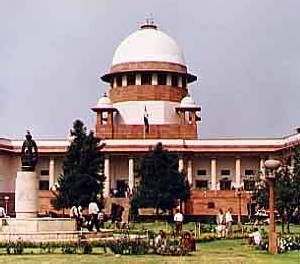
 The Supreme Court has asked the Union Government to put on hold its ambitious and controversial program to increase affirmative action quotas in educational institutions. These quotas increases are mainly aimed at the Other Backward Castes section of Indian society, a section that slipped into the ambit of affirmative action after the Mandal Commission's report being implemented in 1990 by the then incumbent V.P. Singh Government. These communes were then deemed eligible for affirmative action benefits by virtue of them being socially and economically backward, as also because doing so would have been in conformity with the Directive Principles of State Policy. The percentage of seats which would be reserved for members of these communes has been fixed at 27 percent of the total, in keeping with their numeric strength as per the 1931 census.
And that is where the entire policy fell foul of the court. That a policy should be formulated keeping as its basis a census conducted more than 70 years prior has baffled the court, and not without reason. Does the Government wish to insinuate that the quantum of the population belonging to these communes has remained frozen at the same level for over a century? While it is very much possible that the communes might now comprise a reduced percentage of the total populace, and this prospect would be most attractive to those opposing these reservations, it is equally likely that they might now constitute a higher percentage.
This brings us to the main point of this blog. I have always maintained that affirmative action on the basis of commune or creed is largely self-defeating as it rarely if ever addresses the real issues, and risks being monopolized by the more affluent sections of the communes/creeds in question. The standard mode of implementation followed by the Indian state also doesn't allow for much reform on a continuous basis, something that is imperative for an affirmative action program to be deemed to be truly responsive to the needs of the communes whose troubles it wishes to alleviate.
The haste by which the Government was attempting to push this piece of legislation and its inability to answer queries on why the 1931 census and not the more recent 2001, or for that matter, even the 1991 census (in case the 2001 census' computations should still be ongoing) was employed to determine the exact percentage of seats to be reserved under the program proposed somehow suggests that the State was trying to subvert the process of natural justice in its pursuit to be seen as socially aware.
I don't wish to support such a view. The State was being its usual self: plain old incompetent. I mean, it's a cardinal rule that you base your calculations on the most recent data, data which would, logically, be the most accurate approximation to the current situation. Then how could the State mess up so badly?
This blog has always stated its support for affirmative action based on economic considerations. While economics alone cannot be deemed to be enough, by that record, even a communal identity should also not be enough. The case for economics as 'one' of the parameters, and perhaps this being already a part of the system by way of the 'creamy layer' proviso, is strengthened by the fact that while it is accepted that the designated communes do suffer from a systemic bias against them, once a member becomes sufficiently emancipated by way of his financial and social status, the member shouldn't then be able to claim the benefits of affirmative action. Should such a member's offspring, by some quirk of fate, again fall short of the emancipation definition, then the same would become eligible, but not if the same continues on the same level as the parent.
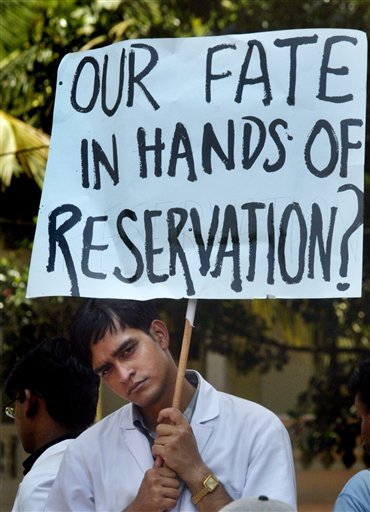 The problem doesn't lie so much with the intention behind the approach, as in the manner in which the issue is sought to be resolved. This is not an issue which can be resolved overnight; reservations or affirmative action cannot be seen as the panacea for the issue. At best, it is one manner of reaching the goal, but it needs to be supplemented with more concrete measures to remove or reduce the institutionalized biases which make coercive measures such as the one proposed by the Government necessary and required. Till such time, reservations are at best a piecemeal alternative, incapable of satiating the hunger of the designated classes for emancipation.


