Showing posts with label economics. Show all posts

Saturday, May 31, 2008

Fuelling woes....

This was a dismal week as far as the Union Government was concerned. Suddenly, the ‘achievements’ of the last four years have become meaningless. All those guarantees for rural employment, and loan waivers, and still people go ticking you off for being compelled to pay a ‘wee’ bit more for the groceries……one wonders what would one have to do to impress these blokes! If the fuel price crisis wasn’t enough, what with the state petroleum companies literally on the deathbed, global crude prices at an all time high, and food prices zooming up faster than a ISRO satellite in space, the loss of Karnataka was the proverbial last straw. I bet that the boffins in the AICC must be scratching their heads or pulling their hair out (depending on whether they have a shiny pate or not), wondering aloud, “Can we possibly do any worse?”

Prices, and more particularly fuel prices, have always been a sensitive issue with governments; they could and have been seen to cause the downfall of many a government over the world. And in India, with our populist political class, which simply frowns on pragmatism and long-term vision (and that isn’t because nearly half of them are geriatrics who are more suited for a nursing home than for Parliament…), price hike considerations simply mean that you are left with two options: one, raise prices and commit political suicide, or let prices stay the way they are and compel the nation to undertake financial and economic suicide.

Surely suicide is a strong term here, you say? Hardly so. Let us evaluate each option more closely.

Fuel prices don’t just affect your ability to go for long drives along the Bandra Reclamation or Palm Beach Road (depending on which part of Mumbai you stay); they influence the logistics costs of transporting right about everything from tomatoes to horses to automobiles, and of course the tykes commonly known as ‘humans’. So, even an infinitesimally minute raise of just 0.000001% in the prices of automobile fuels would mean that the ‘crooked capitalists’, those ‘slaves of Mammon’, (to quote the Communists), would get yet another opportunity to raise prices for just about everything.

And we aren’t even looking at cooking fuels yet. Raise the prices for those, and you will have the populace marching to the Legislature, demanding that someone be scalped, guillotined, hung, drawn, quartered, and just for a thrill, cooked on a low flame using some expensive cooking fuel paid for from the bloke’s own pockets. And considering the propensity of our legislators to be ever so enterprising, those pockets are bound to be pretty deep, and the cooking ever so slow and tortuous (if not the cooking, the expense certainly would be…).

So let fuel prices be as they are. I mean, who on this earth wants things to be more expensive (other than those pesky capitalists, bourgeois rascals, out to make a buck at the proletariat’s expense)? So what if the state petroleum companies are going bankrupt? How dare they go broke? They have mismanaged themselves, that’s for sure……and now they want us to raise fuel prices to cover up their ineptitude? NO SIR! We may be stupid and impractical, buffoons and idiots of the highest order, conniving and snivelling rats, but we would be damned if we were to allow you to do what is right for you.

On a more serious note (and I want to end this blog with this), the energy crisis is finally looking the world in the face. Oil producers may be profiting from this sudden increase in global prices, but in the end, resentment against them is also increasing manifold. And where there is resentment, there is a sense of being betrayed, a modern day Dolchstoßlegende, and the last time such sentiments arose, calamity (read war) struck the land. Oil importers need to comprehend the fragile nature of their existence, being wholly dependent on the fuel being brought in. The time to face the energy crisis is now.

We need to understand that a government of the people does not seek to mollycoddle its people; it seeks to protect them, yes, but even a mother sometimes feels the need to punish her children. She doesn’t love them any less, but the beating is for their own good. So it is with fuel prices.

If we do not raise these prices now (or do something to ensure that we aren’t too way off the global price mark), we may end up endangering the health of the very enterprises that are meant to safeguard our future. Oil prices may drop in the near future, and consequently domestic prices also will drop. It is time we evaluated whether we will bear the prick of the injection now, or suffer the agony of an amputation later on. The choice is ours and ours alone to make. So choose wisely.

Friday, May 04, 2007

Money matters...

I read in the newspapers and watched on the television about how everyone wants to make Mumbai a global financial hub, about how they envisage Mumbai could rival New York and London as a destination for investment banking. Of course, this would require tremendous infrastructure upgradation and development, which would require equally tremendous amounts of capital investment.

While the investment and the necessary infrastructure could be created using grants from the Union Government, it is apt time that we start to evaluate as to whether we can make the city self-financing. Every March 30th, we hear of how the Mumbai region alone contributes around 33 percent of the total tax revenues of the country. Nice. So, we pay so much tax. Now why isn’t all that tax money being seen to do any good for the people who pay it?

Tax, in my view, is akin to a service charge. The State provides services like roads, electricity, water supply, education infrastructure, healthcare facilities et al, and in return asks people to pay for having used them. A fair deal, if you ask me. The only flaw in the whole affair is that the State is not really seen to be doing a good job at providing these services. So what do we do? Privatise them? Hardly so. Privatisation of all and sundry services is hardly the panacea to our problems. It may be easy in the short term, but in the long run, matters could turn out to be quite different.

One argument put forward for the poor state of affairs is that there is too much centralization of responsibility. Ok, so make the local self-governments responsible for these services. But then, the local SGs would complain about the paucity of money. That’s where the tax revenues could come in.

Say, a particular region, as per the IT department’s classification, generates an optimistic figure of Rs. 1000 crores as central tax revenues. Rather than diverting 100 percent of these monies to the Union Government and then redirecting a part of it back to the said region, why can’t we at the very onset demarcate a rough 10 percent of the monies for the region, an additional 10 percent for the state in which the region lies, and send the rest to the Union Government? That way, the Union Government gets 800 crores in its kitty, and the region gets around 100 crores for its own use.

Now, the point I am trying to make here is that a performing region would have a higher quantity of demarcated funds as opposed to a non-performing region. Consequently, the system is to be seen to reward performance. You perform well, you get rewarded accordingly. The non-performer would feel the pinch and would try to use the funds demarcated for the current financial to improve its chances at a higher demarcation next year. Of course, one cannot be permitted to increase one's tax revenues by increasing the tax rates, so that is one objection nullified.

This system should ideally cause a competition for higher demarcation akin to the one seen now, only unlike the current system wherein politics often has a lot to play; this system would look at performance and certain other factors when considering demarcation.

What do I mean by “certain other factors”? A region like Orissa cannot be expected to be able to match the performance of Mumbai in a span of five years. Keeping factors such as the median income, poverty rate, unemployment rate, literacy levels (both academic and functional) etc. in mind, a higher rate of demarcation could be envisaged, as in Orissa could merit a demarcation of 40 pc instead of 10 pc as in the case of Mumbai. The point of course is that Mumbai, being such a high performer, would find even the 10 percent allocation to be worthwhile.

Of course, this system reads too much into the tax revenues generated from a particular region, which may not be truly indicative of real performance. But, it must be comprehended that other than this, there exists no clear-cut source of indication as to how exactly a certain section is growing. I am poor at statistics, but then I am sure that statisticians can come up with some formulation that would be able to define how much should be demarcated for a region on the basis of its tax revenues for the previous financial year and any other factor that may be deemed valid.

I may be too small a fish for my idea to matter, but to my simpleton mind, this seems like a winner. Mr. PC, would you approve?

Friday, March 30, 2007

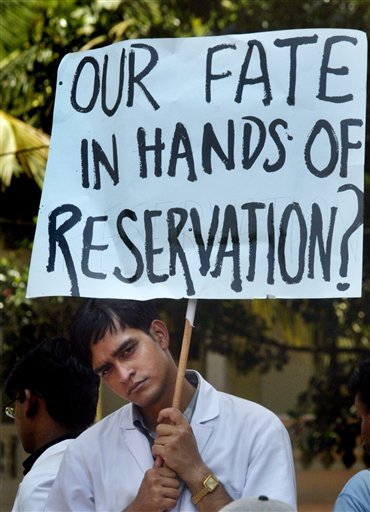
Reservation woes...

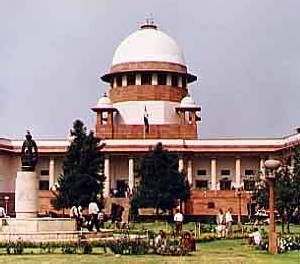
The Supreme Court has asked the Union Government to put on hold its ambitious and controversial program to increase affirmative action quotas in educational institutions. These quotas increases are mainly aimed at the Other Backward Castes section of Indian society, a section that slipped into the ambit of affirmative action after the Mandal Commission's report being implemented in 1990 by the then incumbent V.P. Singh Government. These communes were then deemed eligible for affirmative action benefits by virtue of them being socially and economically backward, as also because doing so would have been in conformity with the Directive Principles of State Policy. The percentage of seats which would be reserved for members of these communes has been fixed at 27 percent of the total, in keeping with their numeric strength as per the 1931 census.

And that is where the entire policy fell foul of the court. That a policy should be formulated keeping as its basis a census conducted more than 70 years prior has baffled the court, and not without reason. Does the Government wish to insinuate that the quantum of the population belonging to these communes has remained frozen at the same level for over a century? While it is very much possible that the communes might now comprise a reduced percentage of the total populace, and this prospect would be most attractive to those opposing these reservations, it is equally likely that they might now constitute a higher percentage.

This brings us to the main point of this blog. I have always maintained that affirmative action on the basis of commune or creed is largely self-defeating as it rarely if ever addresses the real issues, and risks being monopolized by the more affluent sections of the communes/creeds in question. The standard mode of implementation followed by the Indian state also doesn't allow for much reform on a continuous basis, something that is imperative for an affirmative action program to be deemed to be truly responsive to the needs of the communes whose troubles it wishes to alleviate.

The haste by which the Government was attempting to push this piece of legislation and its inability to answer queries on why the 1931 census and not the more recent 2001, or for that matter, even the 1991 census (in case the 2001 census' computations should still be ongoing) was employed to determine the exact percentage of seats to be reserved under the program proposed somehow suggests that the State was trying to subvert the process of natural justice in its pursuit to be seen as socially aware.

I don't wish to support such a view. The State was being its usual self: plain old incompetent. I mean, it's a cardinal rule that you base your calculations on the most recent data, data which would, logically, be the most accurate approximation to the current situation. Then how could the State mess up so badly?

This blog has always stated its support for affirmative action based on economic considerations. While economics alone cannot be deemed to be enough, by that record, even a communal identity should also not be enough. The case for economics as 'one' of the parameters, and perhaps this being already a part of the system by way of the 'creamy layer' proviso, is strengthened by the fact that while it is accepted that the designated communes do suffer from a systemic bias against them, once a member becomes sufficiently emancipated by way of his financial and social status, the member shouldn't then be able to claim the benefits of affirmative action. Should such a member's offspring, by some quirk of fate, again fall short of the emancipation definition, then the same would become eligible, but not if the same continues on the same level as the parent.

The problem doesn't lie so much with the intention behind the approach, as in the manner in which the issue is sought to be resolved. This is not an issue which can be resolved overnight; reservations or affirmative action cannot be seen as the panacea for the issue. At best, it is one manner of reaching the goal, but it needs to be supplemented with more concrete measures to remove or reduce the institutionalized biases which make coercive measures such as the one proposed by the Government necessary and required. Till such time, reservations are at best a piecemeal alternative, incapable of satiating the hunger of the designated classes for emancipation.

Wednesday, March 21, 2007

Are we playing dice with the economy....?

Politics and wise economics are never quite the same. Please note, I am not saying that politicians don’t look at practical solutions; just that they rarely if ever look at the right solution. And as and when they do happen to get hold of such a solution, they manage to make a mess of things by their opportunism and their sheer incompetence. I mean, why is it so difficult to convince people about the practical benefits of a scheme when it is so ‘easy’ to persuade them of the efficacy of one’s political outfit and how it is better than the opposition?

The S.E.Z. (Special Economic Zone) issue is raging now, and politics is overshadowing economics again, although I am sceptical about whether one can truly call it a wise economic decision in the first place. I happened to read Nitin Desai’s article on whether the zones per se were a good idea, and I feel everyone should at least go through the piece, if not to understand the whole gamut of the SEZ issue, but just to understand why there is so much opposition to the scheme.

What may be touted by politicians to be beneficial to the people is rarely ever so; they aren’t where they are to serve the people; they have many more benefactors whose benedictions they have to repay, and in the short period that their tenure lasts, it is all the more the urgent that they do something substantial. Nitin makes a fine point when he makes a distinction between a business-friendly government and a market-friendly government as that between a hegemonic gatekeeper and a benign, albeit powerful, guardian. The Indian State, and its bureaucratic institutions love the role of a despotic tyrant when it comes to imposing rules and regulations on industry, and cannot be expected to be amenable to a role wherein their role would require them to be sympathetic towards everyone sine prejudice.

I never quite understood the idea as to why the zones are focussing mainly on export-related production alone. I mean, if you want to promote exports alone, why not improve the general infrastructure? It would also promote domestic growth, and in turn your capability to export also would be augmented.

I believe PC, our dear ‘beloved’ Finance Minister, is not that enthusiastic about the whole affair, considering that his Ministry will bear the biggest brunt of the concessions that are expected to be rolled out to those investing in creating such zones. Tax concessions and the expected reductions in domestic tariffs once industries shift to these zones are expected to set back revenue collections by a mind-boggling 1,75,000 crores or Rs. 1.75 trillion, and this is simply not an affordable scenario, not while our fiscal deficit is still at a worrying level.

The debate over the zones has mainly emerged over land-acquisition issues and the matter of inadequate compensation being given to land-holders. The Indian State is notorious for its high-handed and absolutely deplorable approach in similar situations, and needless to say, they have done no better in this case as well. That the so-called proletariat government of West Bengal indulged in the act perhaps illustrates that nothing is sacrosanct in politics.

Nitin has made a very valid point when he states that the absolute carte blanche that the State is wont to give to the SEZ developers is absolutely deplorable. Where the State, the protector of the weak, has failed in its duties, it is futile to expect the SEZ developers to be concerned about the rights of landholders, and yet there are cases, very heartening ones at that, wherein developers have made the landholders as stakeholders in the project, and have ensured jobs and means of livelihood for the displaced people.

Nitin says, and I quote, “If the policy regimes that are to apply to the SEZs are a good idea, they should be made applicable throughout.” That they are not suggests that we aren’t sure of whether the scheme will work, i.e. we are experimenting with the notion. The point remains as to whether this is an experiment we can afford doing.

I Quote...

Quote of the Day